
Compare Values on a Russell County Property Record
No single figure defines a Russell County property value. The Appraiser estimates market value first. Kansas classification rules convert that estimate into an assessed figure. A recorded transaction can add its own sale reference. ATCi also splits land and improvement components, so each number should travel with its label, tax year, and the date it was viewed.
| Value | What It Is | Where |
|---|---|---|
| Appraised or market value | The Appraiser's estimate under Kansas rules | ATCi property card |
| Assessed value | The class-specific portion of appraised value | Appraiser record and tax system |
| Last sale or consideration | A figure tied to a dated transfer, when displayed | ATCi sales fields and recorded deed |
| Land and improvements | The allocation between land and buildings | ATCi value tables |
Residential property is assessed at 11.5 percent in Kansas. Commercial and industrial property carries 25 percent, vacant lots 12 percent, and other classes their own rates. Agricultural land stands apart. It is valued by productivity rather than ordinary fair-market methodology, which is why an assessed figure rarely matches either an appraised estimate or a sale price.
Read Russell County ATCi Value Fields in Context
The county-linked ATCi Parcel & Tax Search accepts situs, owner, parcel, Quick Ref, city, subdivision, block/lot, S-T-R, and appraised ranges. A parcel card can span current and prior tax years. Owner details, land, buildings, inspections, permits, comments, and sales may all appear. Some fields stay empty on some parcels.
One courthouse parcel at 401 N Main shows why labels matter. Its 2026 search result listed $3,194,690, while the detailed card showed $3,189,450. The gap is real money. General information listed Acres 0 and Market Acres 1.60. Save the screen, the label, the tax year, and the AS OF date, then ask the Appraiser which field governs the intended use.
Open the public courthouse parcel used to inspect Russell value fields.
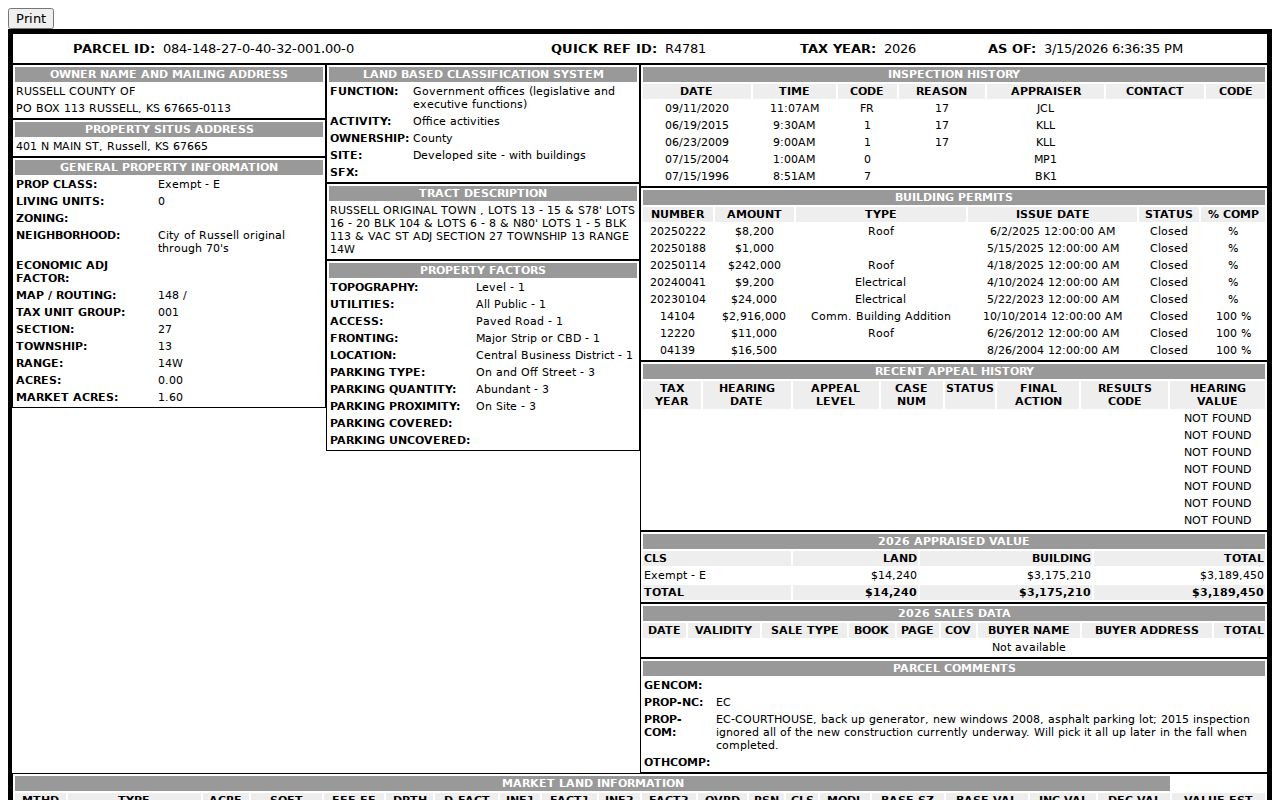
Each Russell value field needs its date and label.
Look Up a Russell County Property Value by Address
This workflow retrieves the assessment figures without turning the task into a tax-bill search.
- Search the situs in ATCi and verify the parcel ID and legal description.
- Open the relevant tax year and record appraised, assessed, land and building labels.
- Write down the AS OF timestamp and compare prior-year dates separately.
- If sale history matters, capture its date and COV fields, then confirm the deed.
- Appraised value
- The county valuation before the class rate is applied.
- Assessed value
- The class-adjusted tax calculation input.
- Assessment ratio
- The statutory percentage for the Kansas classification.
- Sale price
- A dated transaction figure, not a current appraisal.
Kansas Classification Changes Russell Assessed Value
The Kansas Property Valuation Division lays out the difference between appraised and assessed value. Residential real estate uses 11.5 percent; vacant lots 12. Commercial and industrial real property sits at 25 percent, public utilities at 33 percent, and certain not-for-profit property at 12 percent. Two parcels can share an appraised amount. Different classes then yield different assessed values. The separate property tax records page covers levies, payment status, and protests.
Russell Agricultural Value Follows Productivity Rules
Kansas values agricultural land by use and productivity. Fair-market methodology does not apply. The state agricultural explanation supplies the governing framework, while the Russell County Appraiser assigns the parcel's class and keeps the local record. Don't compare that figure to a home's asking price. When a parcel mixes uses, record each class shown and ask how the total was assembled.
The 2026 Russell Reinspection Adds a Date Layer
The Appraiser's 2026 notice concerns physical reinspection. The work begins in the City of Russell, six years after the last full inspection and a hailstorm that affected the area. The office inspects about 17 percent of real property each year and all property within six years. Read the official assessment study and reinspection notice.
A 2026 city parcel can shift for several reasons. Inspection findings, corrections, and market evidence all play a part. The study calls residential slightly upward to stabilizing, commercial slightly upward, and vacant lots stabilizing, but those are broad trends rather than any single valuation.
Sale Price, Deed and SVQ Are Different Russell Records
A sale field in ATCi, a deed, and a Real Estate Sales Validation Questionnaire exist in Russell County records. These are three different records. The deed records the conveyance itself. ATCi may display a sale date, price, or COV. The Kansas questionnaire gathers financing, market exposure, adjoining-property, and distressed-sale facts for valuation work.
The Register limits completed SVQ access to authorized persons. A displayed sale price can also mislead. This happens when a transfer involved related parties, unusual financing, multiple parcels, or personal property.
Note: Confirm a sale's legal description and date before comparing it with the current Russell County property value. Do this before any comparison with the current Russell County property value.
Russell Ratio Studies Are Statistical Context
The Kansas ratio studies compare appraised values with qualifying sale prices across classes and jurisdictions. They are oversight context, not an appraisal. A countywide ratio cannot establish what one Russell County house, farm, or storefront would sell for.
Use the parcel card for the value of record. Use a deed for transfer evidence. Rely on a qualified appraisal for market analysis. When comparing several Russell County property values, hold the class, valuation year, and source constant. Otherwise an apparent neighborhood gap may reflect unlike records, timing, or classifications rather than unlike market evidence.
What a Russell County Assessor Value Cannot Prove
An assessed value proves less than people assume. It does not set a boundary, prove title, disclose every condition, or predict a sale price. Exemptions and classifications can change taxable treatment without touching the appraised estimate. A permit summary can identify work without establishing construction quality. Mapped acreage is not a survey.
For a purchase or sale, weigh the dated official record against the deed, inspection evidence, and a fitting market appraisal. For taxes, use the Treasurer and protest sources. Don't treat the value table as the amount due.
Value versus price. Russell County assessed value is a tax-calculation input, not a guaranteed sale price or an independent parcel appraisal.